
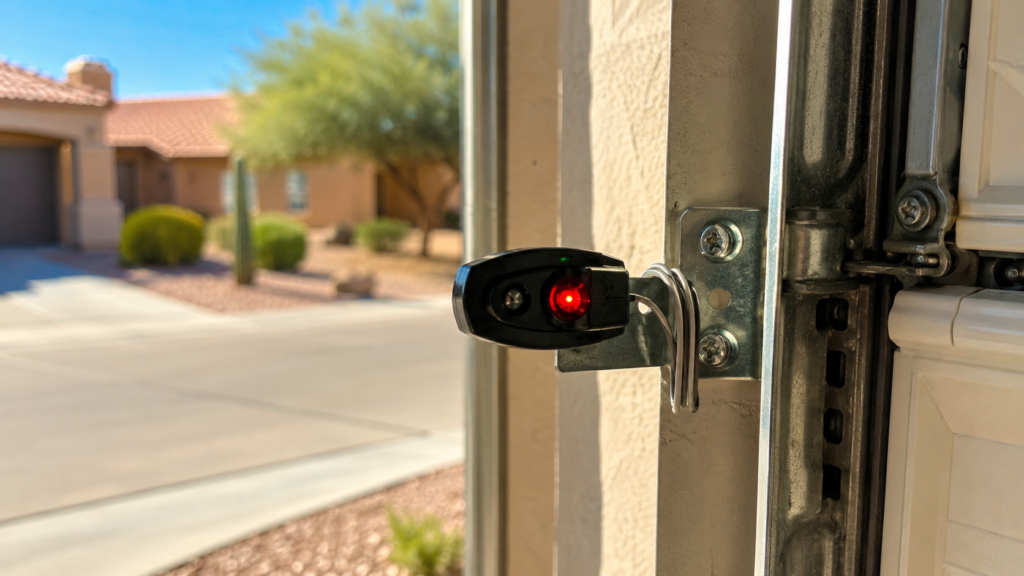
If your garage door suddenly refuses to close – or reverses back up the second it touches the floor – the culprit is almost always a pair of small black boxes mounted a few inches off the ground on either side of the door track. These are your safety sensors (also called photo eyes), and when one of them starts blinking, it’s trying to tell you something.
The good news: a blinking sensor doesn’t always mean an expensive repair. In Phoenix-area homes especially, sensor issues are often caused by dust, sun glare, or a bump that knocked the bracket out of alignment – all things a homeowner can check and often fix in a few minutes. Here’s what that blinking light is telling you, and seven things to check before you call in a professional.
How Garage Door Sensors Actually Work
Every modern garage door opener has two safety sensors mounted about 4-6 inches above the floor on each side of the door. One sensor sends a continuous infrared beam; the other receives it. As long as that invisible beam is unbroken, the door is free to close. The moment something blocks it – a pet, a stray box, a misaligned bracket, or even a puff of dust catching the light wrong – the receiving sensor’s LED starts blinking, and the opener refuses to close the door or reverses it immediately.
That blinking light is a diagnostic tool. A steady green light on both sensors usually means they’re aligned and communicating. A blinking or solid red light on one side means the beam is broken or the sensors can’t “see” each other. Knowing which pattern you’re looking at is the first step to fixing it yourself.
1. Misaligned Sensors
By far the most common cause, especially after a garage door has been bumped by a car bumper, a lawn mower, or even an overenthusiastic vacuum. The two sensors need to be pointed at each other with near-perfect precision – even a fraction of an inch off can break the beam.
DIY fix: Loosen the wing nut or screw holding each sensor bracket, gently adjust one sensor at a time until the indicator light turns solid, then retighten. Don’t over-tighten, or you risk knocking it out of alignment again the next time the bracket gets bumped. If your sensors keep drifting out of alignment no matter how carefully you adjust them, the bracket itself may be bent or the mounting track may be warped – at that point it’s worth having our team handle safety sensor alignment properly so it doesn’t become a repeat problem.
2. Dust, Dirt, or Cobwebs on the Lens
Garage door sensors sit close to the floor, which means they collect dust, pollen, cobwebs, and – especially in Arizona garages – a fine layer of desert dust faster than almost any other part of the door system. A dirty lens can scatter or block enough of the infrared beam to trigger a false reading, even when the sensors are perfectly aligned.
DIY fix: Wipe both lenses with a soft, dry microfiber cloth. Avoid glass cleaner or anything with ammonia, which can leave a residue that attracts even more dust. Do this every few months as routine maintenance, particularly if your garage door faces the street or gets a lot of foot traffic.
3. Direct Sunlight Hitting the Receiver
This one catches a lot of homeowners off guard, and it’s especially common in sun-heavy climates. If your garage faces east or west, direct morning or afternoon sunlight can shine straight into the receiving sensor and overpower the infrared beam, making the opener think the path is blocked even when it isn’t. It’s a bigger issue for west-facing garages in the summer, when the sun sits low enough to hit the sensor almost horizontally.
DIY fix: Try closing the door at a different time of day to confirm sunlight is the issue. If it is, a simple cardboard sun shade, a small hood or visor over the sensor, or even angling the sensor slightly downward can block the glare without affecting its ability to detect the other sensor. This is a quirk we see often in homes we service around Tempe and Scottsdale, where garages commonly face into strong afternoon sun.
4. Loose, Damaged, or Chewed Wiring
Each sensor is connected to the opener unit by a low-voltage wire that runs along the garage wall or ceiling. Over time, these wires can come loose from the terminal screws, get pinched by a shelf or storage bin, or – more often than people expect – get chewed by rodents that find their way into the garage.
DIY fix: Trace the wire from each sensor back to the opener and check for any visible damage, fraying, or loose connections at the terminals. Gently tug on the wire at the sensor end to make sure it’s seated properly. If you find chewed or frayed sections, the wire will need to be spliced or replaced – a straightforward fix, but one that requires matching wire gauge and making a clean, insulated connection.
5. Something Blocking the Beam Path
Sometimes the fix really is that simple. A recycling bin rolled slightly into the door’s path, a bike leaning against the wall, a low-hanging storage box, or a pet walking through at the wrong moment can all break the beam and trigger the reversal safety feature.
DIY fix: Do a visual sweep of the floor between both sensors before closing the door. It sounds obvious, but this is one of the most frequently overlooked causes – especially in garages used for extra storage.
6. Sensor Damage From Impact or Weather
If a sensor housing has visible cracks, water intrusion, or damage from being knocked loose entirely, no amount of realignment or cleaning will fix it. Arizona’s temperature swings – extreme summer heat followed by cooler nights – can also cause plastic housings to become brittle and crack over time.
DIY fix: Inspect both sensor units for physical damage. If a housing is cracked or the internal LED doesn’t light up at all even with power connected, the sensor itself likely needs replacing rather than adjusting.
7. A Failing Sensor Unit or Opener Logic Board
If you’ve checked alignment, cleaned the lenses, ruled out sunlight, inspected the wiring, and cleared the path – and the sensor is still blinking or the door still won’t close – the sensor unit itself may simply be reaching the end of its life, or the issue may actually be with the opener’s logic board rather than the sensors at all.
DIY fix: There isn’t a reliable DIY fix for a failing sensor unit or logic board. Continuing to force the door closed by holding down the wall button (which bypasses the safety sensors) is not a safe long-term workaround – it defeats the entire purpose of the safety feature. This is the point where it makes sense to have a technician diagnose whether it’s a sensor replacement or an opener motor upgrade that’s actually needed.
Why You Shouldn’t Ignore a Blinking Sensor
It’s tempting to just hold the wall button down and force the door shut when the sensors are acting up, but that bypasses the exact safety mechanism designed to prevent the door from closing on a child, pet, or vehicle. Garage doors are heavier and more dangerous than most homeowners realize – we cover the numbers in more detail in our breakdown of garage door safety statistics for Arizona families, and a malfunctioning sensor is one of the more preventable risk factors on that list.
Other Issues That Can Look Like a Sensor Problem
Not every closing issue is actually the sensors. If the door struggles to close evenly, makes grinding noises, or feels heavier than usual even when the sensors read a solid green light, the real issue might be a torsion spring losing tension or a frayed lift cable – both of which are safety issues in their own right and worth having inspected rather than worked around.
When to Call a Professional
Most of the causes above take five minutes and zero tools to check. But if you’ve gone through the list and the sensor is still blinking, it’s time to bring in a professional rather than keep testing workarounds. A technician can quickly tell whether it’s a simple realignment, a wiring repair, or a sensor that needs replacing – and can make sure the fix actually holds instead of reappearing in a month.
If you’re in the Phoenix area and your garage door sensors won’t cooperate, our repair team can diagnose the issue same-day and get your door back to closing safely. Browse our full range of garage door services to see everything we handle, from sensor alignment to full garage door replacement.
Leave a Reply