
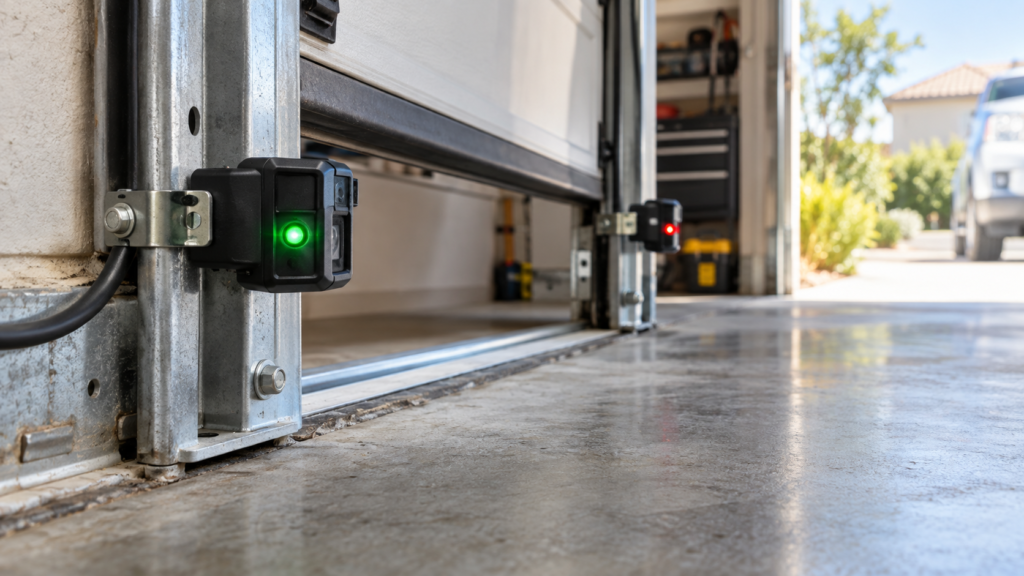
If you’ve ever stood in your driveway pressing the remote while your garage door refuses to budge – and a tiny LED on the floor near the track is blinking at you – you already know how frustrating it is not to know what that light is trying to tell you. Garage door safety sensors use color and blink patterns as a built-in language, and once you know how to read it, most problems take less than five minutes to diagnose.
This guide breaks down exactly what a green sensor light means versus a red one, what it means when either light blinks instead of staying solid, and the step-by-step fixes that solve the vast majority of cases without a service call.
How Garage Door Safety Sensors Work
Every modern garage door opener has two small sensor units mounted a few inches off the floor, one on each side of the track. They work together as a pair: one sensor sends out an invisible infrared beam, and the other receives it. As long as that beam travels uninterrupted between the two units, your opener knows the path is clear and will let the door close normally.
The LED lights on each sensor exist purely to tell you the health of that connection at a glance – no manual required, as long as you know what the colors mean.
What a Solid Green Light Means
A steady, solid green light (usually on the receiving sensor) is the “all clear” signal. It means the sensor is receiving power, the beam is connecting properly with its partner sensor across the garage, and there’s nothing obstructing the path. If both sensors show solid, non-blinking lights, your sensors themselves aren’t the problem – even if the door still isn’t closing.
What a Blinking Green Light Means
A blinking (rather than solid) green light almost always points to alignment drift. The sensor is receiving power, but the beam connection to its partner sensor is intermittent – meaning the two units aren’t pointed precisely at each other anymore. This is extremely common after:
- A garage wall or shelving unit gets bumped, nudging a sensor bracket
- Seasonal temperature swings cause the mounting bracket to shift slightly
- A stored item (bike, ladder, storage bin) gets moved and brushes against a sensor
Because the beam only needs to be off by a few degrees to start dropping the connection, blinking green is often the first warning sign before a door starts refusing to close altogether.
What a Blinking Red Light Means
A blinking red light is a more urgent signal. On most opener brands, red indicates the sensor has either lost its beam connection entirely or is sensing a genuine obstruction in its path – a stray leaf, a toy, a pet, or even a spiderweb across the lens can trigger it. Red can also indicate:
- A dirty or fogged lens – dust and pollen buildup (common in Arizona garages during monsoon season) scatters the infrared beam enough to register as blocked
- Wiring damage – a chewed, pinched, or corroded low-voltage wire disrupts the signal even when the lenses are clean and aligned
- Direct sunlight interference – strong afternoon sun hitting a sensor lens directly can wash out the infrared beam and cause a false “obstruction” reading
If the red light is solid rather than blinking, that typically means the sensor has lost power altogether rather than sensing an obstruction – check the wiring connection at the sensor and at the opener unit.
Green vs. Red: Quick Reference
| Light Pattern | What It Means | Likely Cause |
|---|---|---|
| Solid green | Connection healthy | No action needed |
| Blinking green | Beam intermittent | Minor misalignment |
| Blinking red | Beam blocked or lost | Obstruction, dirty lens, or misalignment |
| Solid red / light off | No power to sensor | Wiring or power issue |
| No light at all | Sensor not receiving power | Loose wire, tripped breaker, disconnected wire |
How to Fix Blinking Garage Door Sensors
Most blinking-light issues are solvable in under 10 minutes with no tools beyond a soft cloth:
- Clear the path. Walk the full width of the door and remove anything sitting between the two sensors, including low-lying items like a stray hose or a child’s toy.
- Wipe both lenses. Use a soft, dry cloth to clean dust, cobwebs, and pollen off each sensor’s lens. In dusty environments, this alone resolves a large share of blinking-light calls.
- Check alignment. Both sensors should sit at the same height and point directly at each other. Loosen the wing nut on the bracket, gently adjust the sensor until the light goes solid, then retighten.
- Inspect the wiring. Follow the low-voltage wire from each sensor back toward the opener, checking for pinches, fraying, or chew marks – especially if you store items near the wires or have had rodent activity in the garage.
- Block direct sunlight. If the issue only happens in the late afternoon, a simple cardboard shade taped above the sensor (as a temporary test) can confirm sunlight is the culprit.
- Power-cycle the opener. Unplug the unit for 30 seconds, then plug it back in. This resolves occasional communication glitches between the sensors and the opener’s circuit board.
For a deeper walkthrough of each individual failure point – including what to do if the lights go solid but the door still won’t close – see our full guide on garage door sensor blinking causes and DIY fixes.
When to Call a Professional
DIY troubleshooting solves most cases, but it’s time to bring in a technician if:
- The lights stay misaligned even after you’ve manually adjusted the brackets
- You find visible wire damage, corrosion, or exposed wiring
- The sensors show solid green (properly connected) but the door still won’t close – this usually points to a motor, limit switch, or circuit board issue rather than the sensors themselves
- The problem keeps recurring every few days despite cleaning and realignment, which often signals a bracket that’s no longer holding its position and needs replacement
Our team handles safety sensor alignment as a standalone service if you’d rather skip the troubleshooting and have it diagnosed and corrected in one visit. And if the sensors check out fine but the door itself isn’t responding, our garage door repair and opener motor upgrade services cover the rest of the system.
Frequently Asked Questions
Why is only one sensor light blinking and not the other? Typically the sensor that’s blinking is the one struggling to receive the beam – check that unit’s alignment and lens first, even though the root cause can sometimes be a dirty lens on the opposite sensor blocking the signal from leaving.
Can extreme heat affect sensor performance? Yes. In hot climates, sensor brackets can expand and contract slightly with temperature swings, which is a common reason sensors that were aligned in spring start blinking again by mid-summer.
Is a blinking sensor light dangerous? Not by itself – it’s the safety system doing exactly what it’s designed to do. The risk is ignoring it and forcing the door to close manually, which defeats the obstruction-detection feature the sensors exist to provide.
Do all garage door brands use the same red/green pattern? Most major brands (Chamberlain, LiftMaster, Genie) follow the same general green-good/red-problem convention, but always check your specific opener’s manual, since a few models reverse the colors or use a single-color LED with different blink counts instead.
The Bottom Line
A blinking sensor light isn’t a malfunction – it’s your garage door system telling you exactly where to look. Green means the connection is close but not quite right; red means something’s actively blocking or breaking the beam. Walk through the clean-align-inspect sequence above, and if the lights still won’t hold steady, our technicians serving the greater Phoenix area – including Scottsdale and Tempe – can have your sensors realigned and your door working safely again the same day. Get in touch to schedule a visit.
Leave a Reply